
A child may sing the alphabet confidently and still struggle to read a short word. Teaching phonics helps learners connect written letters and letter groups with the sounds in spoken words. For children learning English, that work needs to sit alongside vocabulary, listening and meaningful talk.
This guide offers an adaptable lesson routine for teachers in language centres, primary schools and international classrooms. Follow your school's chosen phonics programme and sequence; the example below is a planning model rather than a replacement curriculum.
Before introducing a new spelling pattern, check a few familiar sounds and words individually. Can the learner recognise the written letter or group? Can they blend known sounds into a word? Can they hear and separate sounds in a spoken word?
Keep the check brief and low pressure. A child who joins a chorus may still need support working alone. Record the particular skill to revisit, rather than describing the learner simply as “weak at phonics.”
The British Council's phonics overview explains the connection between letters, sounds and words. The Education Endowment Foundation's evidence summary supports explicit, systematic teaching while emphasising that decoding instruction must be accompanied by vocabulary and comprehension work.
In practice, choose words containing sound-spelling correspondences already taught. Briefly establish their meaning through a real object, action or picture, then ask children to attend to the print when reading. Guessing from a picture should not become the reading strategy.
The timings below are a starting point. Adjust them for age, attention, class size and the routines of your programme. For the sample words sat, sit and mat, first confirm that the relevant correspondences are familiar.
Show a small set of known letter cards in a changing order. Give everyone thinking time before inviting individual responses. Include one previously taught word so you can see whether children connect isolated sound knowledge to reading.
Model the sound or blending skill specified by the lesson. Point to the relevant spelling as you say the sound, using the pronunciation guidance in your programme. Avoid adding unnecessary extra vowel sounds to consonants, which can make blending harder.
Demonstrate reading one word, then repeat the demonstration with learners helping. Keep explanations short enough that children have time to practise.
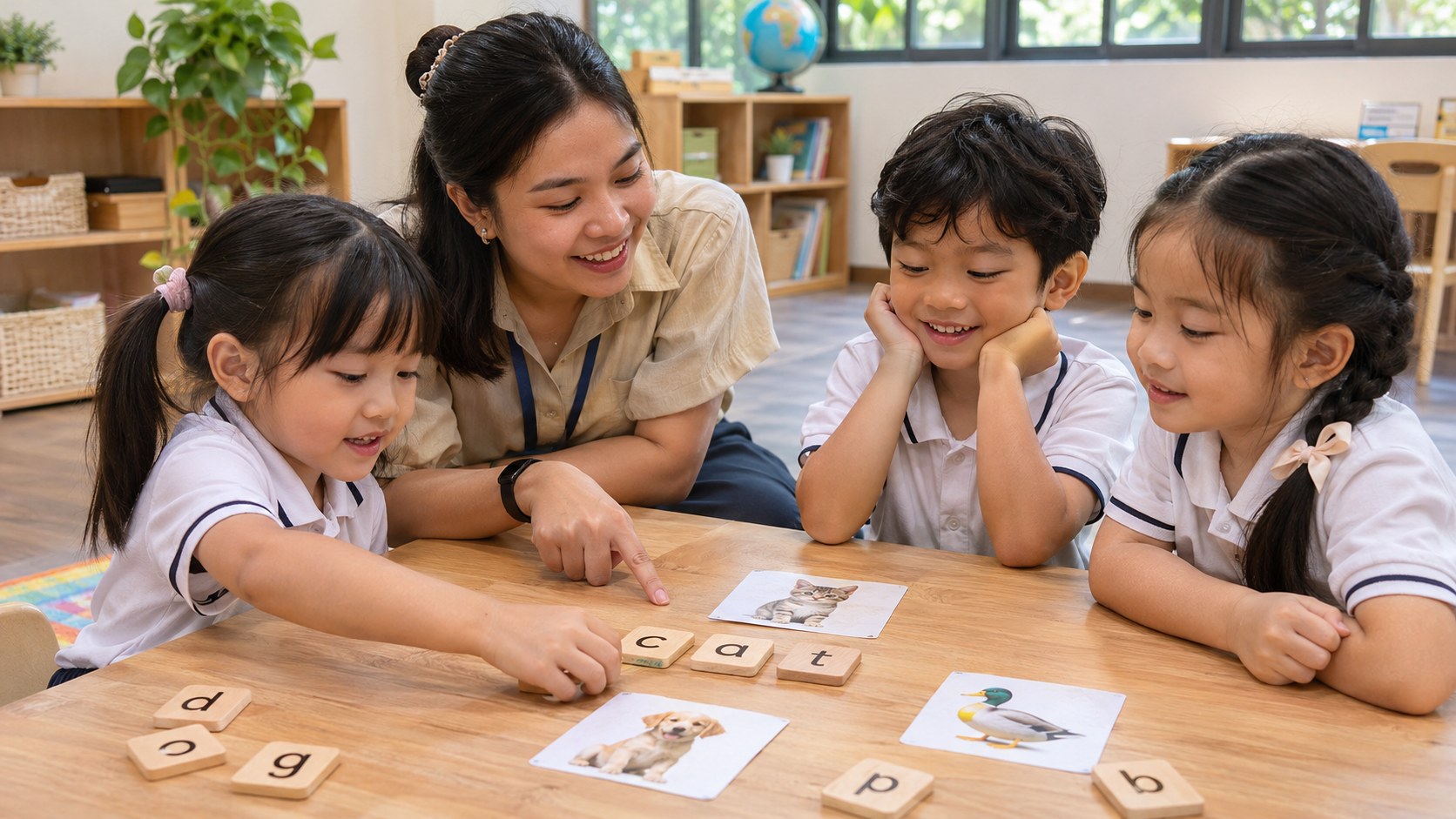
Ask pairs to build and read a few suitable words with letter tiles or cards. One child builds, the other reads, and then they swap. Circulate and listen to each learner rather than assuming that a successful pair means both children understand.
If a learner gets stuck, identify the point of difficulty: recognising a spelling, producing its sound or joining the sounds. Model that step and return to a manageable example.
Say a familiar word. Ask children to identify its sounds and select or write the corresponding spellings. For example, they might build mat and then change it to sat. Ask what changed in both the spoken and written word.
Use a short sentence or decodable text matched to the spellings children have learned. Discuss what it means. Finish with an individual word-reading or spelling check, making a quick note of who needs further practice.
For a child needing more help, reduce the number of examples and repeat your model. For a confident reader, use a new word containing familiar correspondences or ask for a short dictated sentence. More difficult spelling patterns are not the only way to add challenge.
Keep older beginners' materials age appropriate. A learner new to English may already have strong literacy in another language. Find out about that experience before choosing resources.
For a different language focus, see our pronunciation activities and lesson plan.
If you discuss phonics in an interview, explain how you checked learning and adjusted the next lesson. An anonymised planning example can show more than a photograph of a busy activity. Never include identifiable student work without the required permission.
Explore teaching vacancies on Global School Scout and compare the ages, curriculum and literacy responsibilities in each role. Ask prospective schools which reading programme they use and what training new teachers receive.
Reviewed November 4, 2026. Lesson timings and classroom examples are illustrative. Featured image is AI-generated.


Site help, FAQs, blogs, and how our Scouts work